Translate

Saturday, August 2, 2014

An American joker in the country


As I was reading Joe America’s most recent blog, flippantly entitled, “Why discretionary authority is a good thing,” I was struck by his enormous ignorance of the difference between the public and private sectors, and in particular, of both the Philippine and American governments. This transplanted American even has the audacity to tell Filipinos how to run their government, a direct affront to our finer sensibilities. He could be declared persona non grata for abusing our hospitality, but because he made it a point in his blogs to cozy up to those in the higher ups in government, Joe America remains today a very ubiquitous blogger on Philippine social media and is constantly read by thousands of unsuspecting followers, including some influential columnists in the mainstream media.

A representational photo of Joe America from his blog, not his real image.
He started his recent blog by framing the debate about the constitutionally illegal and controversial DAP around two very flawed misconceptions of our own history and culture. If nobody stands up to this guy, he could possibly deconstruct our history as a people and let many believe he is correct.

First, he writes about Filipinos not too trusting of those in authority. Those in authority, Joe America writes, abuse their power and rule autocratically and for their personal gain. They steal money from taxpayers, so Filipinos are rightfully suspicious.

After almost five centuries under foreign colonial rule, it is but natural for Filipinos to become apprehensive of despotic or oppressive government. Filipinos waged a revolution against Spain in 1896, then fought wars of independence against the United States at the turn of the 20th century and Japan during the Second World War, and battled the dictatorial Marcos regime from the early 1970s to the EDSA Revolution of 1986.

The revolution and struggle for independence and democracy by Filipinos were not borne out of simple mistrust of authority. To say so would be to demean their heroism, and gloss over the fact that during those struggles, Filipinos were fighting for true self-determination, a no higher cause for the people to wage.

Second, Joe America blames Filipinos for being emotional by blowing up issues into sensationalist proportions instead of keeping themselves with the facts. He blames the media and the people by feeding on each other, as if the people or general public has equal access and control of newspapers, radio, and television. He fails to see that most of the news are manufactured by a press friendly with government to provide a favourable coverage of the establishment. Absolving the president of his own shortcomings and errors in decision-making, Joe America has nothing to blame but the emotions of the people in portraying the president as another corrupt leader.

Worst of all, Joe America blames dissent and criticism as the principal disruption to a stable leadership necessary to achieve sustainable growth. If the Philippines doesn’t move forward, he has only the people to blame, not President Aquino.

A troubled country like the Philippines, Joe America writes, needs a president who has significant authority and discretionary power. So he concludes that the DAP is a good tool because the president could use it to achieve his objective of sustainable and inclusive economic growth.

When someone does not understand the difference between how a government operates compared to a private corporation, this is the kind of limited thinking process you get. No matter how he prefers the corporate style of management, the government cannot be run simply along profitability lines. Leaders of government are supposed to be representatives of their electors, who by their votes have consented to be governed under a system of laws and a fundamental law called the Constitution. Besides, they are also constrained by their party affiliations, which are necessary in a representative democracy.

Joe America writes: “How does a president succeed if he must subordinate his initiatives to checks and balances from institutions that are divided, filled with political players and incompetents and hostile to change?”

He doesn’t want Congress investigating how the DAP was spent and whether the DAP met its objectives. To him, the Senate cannot substitute the personal views of its members to the decisions of the Executive who would have thought rigorously of the DAP in the first place.

Throw away the Constitution, disregard the laws, or even the ethical behaviour politicians and bureaucrats ought to follow, this seems to be Joe America’s prescription for as long as the results are good. Productivity is all that matters, and to Joe America, this is how Secretary Florencio Abad is exactly running the DBM.

The Philippines should be managed like a corporation—this is Joe America’s prescription for growth. He writes: “There is a clear structure in a corporation, and respect for that structure. There is a big boss and little bosses and a hierarchy of, if not respect, at least obedience. Free speech is tempered by prudence, or the risk of losing promotional opportunities if one offends one of the bosses. It’s not like the chaotic democratic way of open criticism that eventually generates a lack of respect for the leadership and often leads to partisan bickering, turmoil and lack of continuity.”

For all the flaws and warts in his personal views, Joe America credits his growing up in the United States, a nation he says is proud of its values and largely trusting and appreciative of its leaders. He also credits his military service where there are clear lines of authority and discipline, and his long years of experience in a large corporation. “The better part of my life has been spent acceding to the authority of others or delegating and respecting subordinates if they did something differently than I would have done it.”

Would Joe America give the same advice to President Barack Obama and the U.S. Congress on how to run the nation, where adherence to political loyalties and divisions has greatly caused the current gridlock in Washington?

What would Joe America say to the US Congress when it voted recently to sue President Obama for overstepping the powers of the presidency—clearly a show of opposition against discretionary authority of the president?

In his own country, Joe America will probably be dismissed as an ignoramus and a buffoon.

Yes, Joe America is a big joke. Moving to the Philippines in 2005 to live with his Filipino wife and family in the Visayas, he thought he already knew too much about the country and its politicians that he could lecture them on governance. He makes disingenuous assumptions about Filipino culture and the history of our people as if they are correct and grounded on facts.

Listen to Joe America when he writes: “It seems to me Filipinos don’t know how to build a nation. Because they don’t know how to sacrifice. Don’t know how to trust.”

That we don’t know how to sacrifice is a boldface lie. For four hundred years the Spanish colonized us and it took great sacrifices among our revolutionary heroes to fight colonial oppression. Both ways could be interpreted as a sacrifice, that it took us so long to wake up and take arms, and in the process we gave up so many lives not only during the revolution against Spain but also during the wars of independence against the United States and Japan.

On the DAP, Joe America keeps saying it worked and President Aquino was successful in accomplishing his objectives. That “we should get our evaluations right and get rid of emotion and suspicion as a basis for making decisions.”
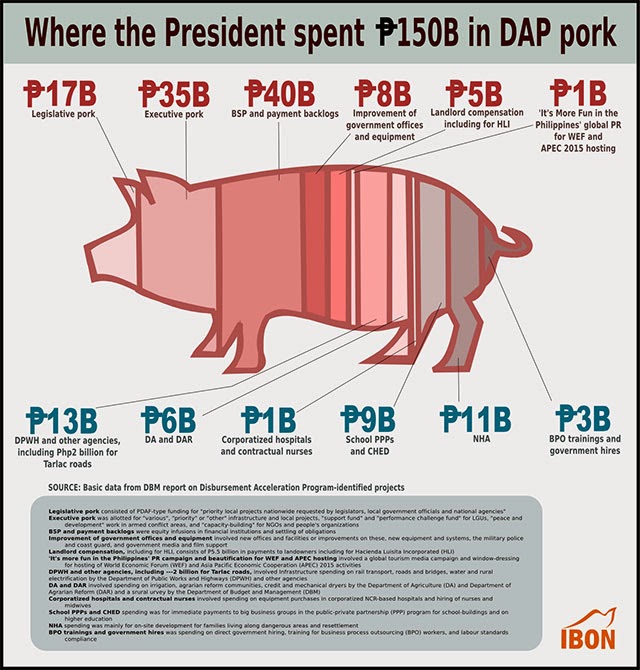
Infographics on DAP, courtesy of Ibon.
Assessed whether the DAP proved successful in pushing economic growth by investing on high-impact programs and accelerating public spending, one study has shown that the DAP as a whole did not significantly create jobs, nor raise incomes and stimulate local economic activity. According to Ibon Foundation, an independent think-tank organization, “the general pattern of DAP spending is not consistent with a stimulus package designed to address the country’s most urgent socioeconomic problems. If the government wanted to stimulate the economy, it could have prioritized labor-intensive rural infrastructure projects.”

In other words, the much-publicized positive impact of the DAP is not completely accurate as advertised. However, Joe America insists it was a highly successful program, notwithstanding its unconstitutionality for violating the budgetary process.

There are also glaring inconsistencies in Joe America’s points of view—he admits that sometimes he contradicts himself. In one blog, for example, he states that the Philippines is an authoritarian society, yet in his recent blog he advocates that the president be given wide discretionary authority because in his opinion a strong executive is not a dictator.

Just consider the last time a Philippine president hijacked his constitutional powers and ruled with an iron fist. Did becoming more powerful make him an effective leader or executive? Was he able to push the Philippine economy forward and sustain its growth?

Joe America is ignoring the true political situation in the Philippines and making wrong assumptions about our culture. Just to be fair with him, read his blog, Society of Honor by Joe America, and after that, you probably won’t read him anymore.

Thursday, July 24, 2014

Dissent and other voices


Did anyone notice the style of cause in the recent case wherein the Supreme Court has struck down certain provisions of the Aquino government’s controversial Disbursement Acceleration Program (DAP) as unconstitutional? For those who may not be aware, the style of cause refers to the name of the case.
 
High on top of the list of petitioners is Maria Carolina P. Araullo, the chair of the Bagong Alyansang Makabayan, followed by individuals known to be left-leaning and representatives of civil society organizations committed to good governance and empowerment of the people. Who else but these much-maligned groups are the ones indisputably fearless to stand up to government’s abuse of power?
 
Those from the right and many rabid supporters of President Benigno Aquino III have easily dismissed the left as irrelevant and a big disappointment. One, who was presumably affiliated before with the left and now a born-again fervent defender of the faith in the Aquino government, questioned the modes of engagement that the left have continued to embrace—the effigy burning and sloganeering that demanded impeachment of the President.
Students from various universities raise their fists after filing a second verified
impeachment complaint against President Benigno Aquino III in the House of
Representatives over his unconstitutional Disbursement Accelaration Program
(DAP). Photo by Manny Palmero.
Araullo vs. DAP, the more popular short name for the Supreme Court decision, represents the victory of people’s dissent over the arrogance of some of our leaders in government, or even perhaps the triumph of the people’s parliamentary struggle over the smugness and cockiness of the raucous rightwing-mongers.
 
Many have confused parliamentary struggle as being confined only in the halls of Congress, a tactical form of engagement strictly reduced to legislative reforms. But parliamentary struggle is not limited to congressional initiatives. It embraces the whole gamut of expressing dissent through legal means such as protests on the streets, messaging on Facebook and Twitter, confronting government decrees or acts through constitutional challenges, and private petitions or complaints of plunder against government officials. Yes, even burning of effigies. Parliamentary struggle adopts all forms of protests and advocacies so long as they do not involve violence, or taking up arms against the government.
 
Under authoritarian regimes, dissenters are persecuted. Hitler executed them, and Stalin sent them to the gulags. Surely, no one, including President Aquino, likes being ridiculed or chastised by the Supreme Court and the public. But democratic societies tolerate dissent, a proof that freedom of speech truly exists.
 
It is also why Joe America, a former banking executive who lives permanently in the Philippines and blogs relentlessly, can continuously and without fear lavish the current government with praises while he paints the Aquino critics, especially the left, as being possessed with evil motives like destroying the government by any means. Or why other defenders of the Aquino dispensation flourish and are easy to find in major Philippine dailies writing their regular columns defending MalacaƱang, and those who roam the various forums on the Internet and flood them with their supercilious and pompous opinions about anything that appears critical of the government.
 
There is nothing wrong in the present public conversation between those who believe in the government and those who are critical of it. This is how a free market of ideas is supposed to work. Give a little and sometimes take a quick poke, the battle of ideas is not won by one side when it says that wrong is right because it says so, or simply because it has been allowed or done before.
 
Just like when President Aquino insists that the DAP is right because everything he does is out of good faith and will redound to the benefit of the people.
 
In a recent speech commemorating the 150th birth anniversary of a great Filipino hero Apolinario Mabini, President Aquino said that the implementation of the DAP was reinforced by their belief that the Supreme Court itself agreed with that kind of mechanism. The president was, of course, referring to the high court’s request for a transfer of funds for the construction of the Manila Hall of Justice and the Malolos Hall of Justice.
 
“They requested for the funds to be transferred to be able to construct buildings that will house the courts. We don’t see anything wrong with this because it speeds up the judicial system in the country,” President Aquino said. The high court’s request was eventually withdrawn after petitions were filed questioning the constitutionality of the DAP.
 
There is something wrong in the President’s judgment. Just because the Supreme Court requested the fund transfer doesn’t mean that the executive can do the same for highly dubious purposes, especially after the high court cancelled their request.
 
The President cannot keep justifying the DAP or whatever he does as being good for the people. As public servant, that’s a given presumption, his covenant of good faith. He cannot rationalize his actions only by their results. More so, when there are allegations that the DAP funds were used to bribe members of Congress in impeaching former Chief Justice Renato Corona, and that the funds were also used to compensate the President’s family for Hacienda Luisita and other landowners. Where is good faith if the allegations were proved to be true?

Members of the Bagong Alyansang Makabayan point to a mascot of President
Benigno Aquino III when they declared him king of the Disbursement Acceleration
Program (DAP).
In his ubiquitous blog on the Internet, The Society of Honor by Joe America, Joe America endorses the DAP debate, “as the freedom to do that is what we fought for when we kicked out the Marcos dictatorship.” “We kicked out” is somewhat presumptuous, if not disingenuous. Joe America himself said he arrived in the Philippines in 2005, or eighteen years after the dictator was driven out of the country by the EDSA People Power Revolution. How did he become a part of the “we” who kicked out the Marcos dictatorship? Does Joe America even understand that the left greatly contributed to waking up the consciousness of the Filipino people against the oppressive Marcos regime?
 
Joe America is your typical opportunist who would dismiss the contributions of the left in building a national collective against oppression in the past, and undermine their role in the continuing struggle for people empowerment in governance. He is embraced by Filipino intellectuals, real and imagined, in their jeremiads against today’s left and the progressive movement. He now lives with his Filipino wife and son in a rural rice-growing area in the Visayas. Joe America says he is a retired banking executive with degrees in Mathematics and Radio and Television Arts. His 30-year working career was based in Los Angeles, California and he has traveled on business or personally to 21 countries. Sounds like someone who would fit the resume of an undercover political operative of an American intelligence agency.
 
Meanwhile, someone from a forum I know is already mouthing the same shibboleths as if they’re coming directly from Joe America’s pen. “Is it because parliamentary struggle requires a little more imagination and innovation, and hard work and marching to the streets and shouting to the top of their tonsils is an easier force of habit than innovating and thinking new things?,” she asks.
 
Like Joe America, she describes the left as political dinosaurs which have become obsolescent and alienated from the rest of the people. In the same vein, Joe America would caution others not to be dragged by the left into their agenda because they are wolves in sheep’s clothing.
 
Joe America and those who are like him do not represent the type of public intellectuals we would like to read and listen to. On one hand, they would pretend to encourage a robust debate, yet in truth they try to muzzle the genuine truth from coming out.
 
The voice of dissent, if we want it to be free, should be allowed to flourish without the cumbersome Joe Americas and his converts telling us that right is wrong or wrong is right just because they say so.