Translate

Showing posts with label DAP. Show all posts

Thursday, October 23, 2014

Bad exemplars of good


History seems to repeat itself quite frequently. Such as a brain cramp I had recently, but unintentionally, which people in my present age would describe as a minor lapse in senior moments.
 
I’m talking about the Hyatt 10, and whether it left us with a noteworthy political legacy or that it was in the grand scheme of things simply an irrational, thoughtless and high-minded display of moral superiority, self-righteousness and arrogance. Perhaps, one might even call it an improbable shot or maybe a fart in the dark. 
 
Someone in an Internet forum I belong to reminded me of the courage of the members of the infamous Hyatt 10 in standing up to their boss, then President Gloria Macapagal Arroyo, when they demanded her to step down or else they resign. This happened in 2005 at the height of the “Hello Garci” scandal involving massive cheating and fraud during the 2004 elections that gave President Arroyo a full six-year term. The scandal precipitated attempts to impeach the President in Congress, and a public demonstration led by former President Cory Aquino asking Arroyo to resign.
 
Some members of the infamous Hyatt 10, left to right: Guillermo
Parayno, Cesar  Purisima, Florencio Abad, Imelda Nicolas, Teresita
Deles, and Corazon Soliman.  Photo courtesy of the Manila Times.

This member raised the ghosts of Hyatt 10, not just to remind me but also to re-educate me on the conditions in the Philippines, which I have left many years ago. Understandably, conditions have changed and I might not be familiar with them as she pointed out. But the emergence of wireless technology took care of that.
 
The Hyatt 10 came from a group of Cabinet secretaries responsible for the then Arroyo administration’s economic management and planning as well as those in-charge of social welfare ad peace negotiations with the country’s insurgents. The Hyatt 10 resignation was this forum member’s rebuttal to my post in the forum about the resignation of two high-ranking cabinet members of Japan’s Prime Minister Abe’s government that such similar resignations are unlikely to happen in the Philippines.
 
Of course, the comparison was off-tangent, without likeness. Prime Minister Abe’s cabinet ministers were elected in Parliament and resigned because of allegations of financial improprieties. The resignation was triggered by shame and the potential scandal to the government, a sacrifice or moral choice Japanese politicians are only too willing to take for the sake of a higher purpose.
 
The Hyatt 10 accomplices, however, were unelected and appointed to serve under the pleasure of the President whom they wanted to resign because they believed she had lost the trust and confidence of the people. It was unimaginable, for example, that an entire office staff would threaten to resign simply on the ground that their manager or supervisor has lost credibility. This was highly unprecedented and the Hyatt 10 never had any legal or moral ground to demand the President’s resignation, except for their arrogance and preconceived notions of moral superiority.
 
Yuko Obuchi, Japan's economy, trade and industry minister bows
during a news conference as she announces her resignation from
cabinet. Photo by Tomohiro Ohsumi/Bloomberg.
Whether Hyatt 10 was a resignation en masse or mass firing is not historically significant, save for the infamy it has engendered. President Arroyo served her full term of the presidency and left office with an improved economy. However, the allegations of fraud and plunder hounded her, which became the bane of her existence after stepping down from the presidency. She is now detained indefinitely pending trial, which is taking the Sandiganbayan an inordinate amount of time to set down.
 
In the meantime, some members of the Hyatt 10 were rehired by the current Aquino government. Florencio Abad, who was also Aquino’s campaign manager during the elections, has been appointed secretary of the Department of Budget and Management. Together with Janet Napoles, Abad has also been alleged as the true mastermind of the multimillion-peso pork barrel scam. He is also the author of the Disbursement Acceleration Program (DAP) which has been struck down by the Supreme Court as illegal and unconstitutional.
 
According to stories circulated in the news media, the steep decline in the popularity of President Aquino in poll surveys persuaded his sisters to prevail upon him to let go of Abad. But here came the Hyatt 10 again to the rescue, threatening the President with their resignation if Abad would be axed. Rumors kept swirling around that the President and some members of the Hyatt 10 were worried about detention in Crame after their term was over. It was the group’s instinct for survival that kept them to stick together. An article by a well-respected journalist has alleged that Abad threatened to expose the President about his involvement in the pork barrel scam and the illegal DAP if he were to be sacked, which suggested that the Hyatt 10 might be hijacking the President by putting a noose around his neck.
 
Dinky Soliman denied all the rumours about the Hyatt 10 ganging up on the President. One of the most outspoken members of the Hyatt 10 during their mass resignation in 2005, Soliman was rehired by President Aquino to her original cabinet post as Secretary of Social Welfare and Development, an appointment which took 4 years before it was confirmed by the Commission on Appointments.
 
Soliman expanded the Arroyo’s conditional cash transfer program, otherwise known as the Pantawid Pamilyang Pilipino Program (4Ps), but which was disparaged by many as a dole-out instead of assisting the poor to get out of their dire straits. She was also criticized for mishandling the relief efforts after Super Typhoon Yolanda hit the country in 2013, even admitting that her agency did not monitor funds given by private donors. Soliman’s detractors, however, were not successful in forcing her resignation as President Aquino stood by her as he did for Abad.
 
Another prominent member of the Hyatt 10, Cesar Purisima who was Arroyo’s Secretary of Finance and was appointed to the same position by President Aquino. Purisima was alleged to have played a significant role in the pork-barrel scandal and the illegal Disbursement Acceleration Program hatched by Budget Secretary Abad.
 
The recycling of the Hyatt 10 conspirators by the Aquino government shows the fungible nature of Philippine politics. Yesterday’s enemies are today’s allies. That is how easily exchangeable Filipino politicians are; there is no ideological basis for their loyalty and trust. If there is anything we can learn from the Hyatt 10 is the politics of opportunism.
 
To consider, therefore, that Filipino politicians, as suggested by my Internet friend, are capable of summoning the better angels of their nature like the Japanese is a huge overstatement. That they would give up their high positions in government to preserve integrity and honesty in government has never happened that frequently in the country’s history and political development. Former Senator Juan Miguel Zubiri resigned from the Senate when the election protest of Aquilino Pimentel Jr. was about to be upheld, thus proclaiming the latter as winner of the election. The same can be said about Senator Juan Ponce Enrile who stepped down as Senate President amid allegations of distributing cash gifts to senators when it was already clear at the time that he was going to be deposed.
 
There were only two significant incidents in Philippine history where the resignation of elected officials really mattered and were triggered by political convictions rather than by a false claim of moral ascendancy akin to the Hyatt 10 political motivation. The first happened during the Tejeros Convention in March 1897 where the first-ever Philippine presidential election was held. Emilio Aguinaldo was elected president over Andres Bonifacio who was acclaimed as leader of the Philippine revolution. Bonifacio humbly accepted his election as Director of the Interior but later withdrew when Daniel Tirona demanded that another person believed to be more qualified should be elected instead of Bonifacio who had no formal education and a lawyer’s diploma. Shamed and insulted, Bonifacio, in his capacity as Supremo of the Katipunan, declared the election null and void. He would later be executed by Aguinaldo’s men.
 
A similar incident happened in 1946 when Luis Taruc, leader of the Hukbalahap, and seven other colleagues from the Democratic Alliance were elected to the House of Representatives but the government of Manuel Roxas did not allow them to take their seats in Congress. The Taruc faction opposed the parity rights amendment to the Philippine Constitution that the United States required as a condition for payment of reparation for the Second World War. Consequently, Taruc and his men would return to the hills to take up arms against the government.
 
The Hyatt 10 resignation in 2005 and the 2014 revival of another of threat of resignation by the same group did not alter the political map nor engender the development of a higher sense of morality in politics among Filipinos. If there ever was a political statement that could be ascribed to the group, it would be that opportunism and arrogance are the necessary building blocks to a successful career in politics and government.
 
To embrace the idea that the Hyatt 10 or the members of President Aquino’s inner sanctum are beyond reproach and possessed with incorruptible qualities is almost analogous to a lowering of the standards of morality and integrity in government. If being fundamentally good is to have other people’s interests in mind, especially by people in authority or in government, then in order to be good, one must exhibit some genuinely selfless motivations.
 
This is not however the underlying motivation of the Hyatt 10, nor of the men or women in President Aquino’s cabinet, or perhaps of the whole body of the current Congress. Goodness and greatness are never the exceptional qualities of our elected leaders. In confronting our moral progress as a society, this cabal called the Hyatt 10 has failed us miserably, and by those who blindly follow their twisted path.

Thursday, August 28, 2014

The unbearable lightness of PNoy’s so-called reforms


In his speech marking the celebration of National Heroes’ Day, President Noynoy Aquino put down the growing popular protests against his administration as disruptive of the government reforms he has initiated. Calling them forces against social reforms, the President’s own pro-administration coalition on the other hand has vowed to continue to fight for his “straight path” of governance.
 
What could yet be his strongest admonition against the popular protest, Aquino branded these protesters as “a few who are determined to bring back the old system of corruption and abuses.”
 
The popular protests against the Aquino government have been inflamed by the President’s own hints of calling for an amendment of the Constitution to extend his term of office and to restrain judicial overreach of the Supreme Court. Stirred up by public clamor for an end to pork barrel politics through total abolition of discretionary and lump sum funds in the national budget, several progressive groups and civil society organizations have joined forces to enlist 6 million signatures for a people’s initiative to enact these legislative reforms.
Popular protests against the Aquino administration gain momentum as several
progressive groups and civil organizations join  forces to gather 6 million
 signatures to enact legislative reform that will totally scrap pork barrel.
Instead of embracing the protesters’ demands, President Noynoy Aquino has chosen to roll the dice. It’s them versus him, the forces of change against the President’s self-convoluted vision of “daang matuwid.”
 
But what are these reforms President Aquino is talking about?
 
He has not achieved much in terms of stimulating the economy except earn some brownie points to upgrade the country’s credit rating. This is a hollow accomplishment since it only means that it is easier for the country to borrow money. Unless public expenditures designed as stimulus translate to more jobs, reduction in poverty and income inequalities, a credit upgrade is nothing but hot air.
 
Former Comelec Chairman Christian Monsod summed it up correctly when he recently criticized those who support the government’s posturing with Charter Change. “They are looking at the wrong places for sustained inclusive growth. Our social reform programs are dead in the water: housing, agrarian reform, ancestral domain, municipal fishermen. They are the poorest of the poor,” he said.
 
Delivery of public services and social programs remains slow and inefficient. Traffic in the biggest city in the country is not freely moving and has affected the flow of goods and made life unbearable to the majority of the population who rely on public transit. The government bureaucracy continues to struggle against red tape and incompetence of the civil service.
 
Public corruption is one of the highest in the region, which brings us to Aquino’s self-proclaimed delusions of “walang korap kung walang mahirap” (there’s no corrupt if there’s no poor) and the “daang matuwid” (straight path).
 
Aquino was successful in placing his predecessor, former President Gloria Macapagal-Arroyo, in jail since 2012 for crimes of graft and corruption and economic plunder. Two years in detention, no trial date has been set for the former president but a number of complaints against her have already been dismissed for lack of evidence.
 
The chief justice of the Supreme Court was successfully impeached by Congress for violation of public trust for not completely disclosing his statement of assets and net worth. But the impeachment is now tainted by allegations that the President bribed members of Congress through his pork barrel, the Disbursement Acceleration Program or DAP, which has been declared unconstitutional by the high court.
 
Last July, the 10-billion-peso-pork-barrel scandal imploded. But this was not due to efforts of the Aquino administration to weed out corruption in government. The Napoles-masterminded scheme of channeling pork barrel funds (the Priority Development Assistance Fund) designated for members of Congress to fake NGOs was exposed through whistleblowers and not by zealous government scrutiny. Only after a congressional investigation did the government really stamp its official approval of going after three leading opposition senators and putting them in jail for charges of plunder. Whether the government will be able to successfully prosecute these senators still remains a big question.
 
The congressional pork barrel known as PDAF has been dismantled when the Supreme Court declared it was unconstitutional; again, not because of the honest efforts of the incumbent administration, but through petitions made by progressive groups and civil society organizations.
 
The same thing happened to the Aquino administration’s own pork barrel, the DAP, which was also declared unconstitutional by the Supreme Court. If not for several progressive groups and civil society organizations, the pork barrel system of illegal and irregular allocation of government funds to members of Congress and to Aquino’s pet programs and projects would not have been exposed. Thus, even the Aquino government’s priority of keeping the straight path was not accomplished by the President and his staff but by the ever-vigilant public.
 
Here is the harsh truth: the Aquino government is planning to subvert the high court’s decision in disallowing the PDAF and DAP by insisting on the President’s discretion to keep lump sum allocations in the national budget, and at the same time, dropping hints of amending the Constitution to restrain judicial overreach of the Supreme Court. Minimizing the influence of the judiciary in a government of separation of powers and checks and balances between the three branches of government is only a prelude to an Aquino imperial presidency. With a subservient Congress on his lap, a populist president like Aquino could easily push for dubious reforms that would keep him in power for a long time.

President Noynoy Aquino insists that his administration was right in implementing the
Disbursement Acceleration Program (DAP) despite being declared unconstitutional by
the Supreme Court.
The current political situation in the Philippines may be warped, but this is not because of a fault in the Constitution. There is no provision in the body of the Constitution that needs to be altered or amended to meet current apprehensions. One only needs to give the Constitution one more thorough and careful reading, asking where and how one would alter it. The wisdom of the framers of the current Constitution and the fears of a re-run of the Marcos dictatorship speak clearly for a new vision of democracy in 1987, after more than two decades of authoritarianism and suppression of civil and political liberties.
 
President Aquino relies heavily on the role of his close advisers who would spin the political issues that beset the government by denial, on one hand, and by offering a better and more palatable version to the public, on the other. For instance, despite the Supreme Court’s decision on the unconstitutionality of the DAP, Aquino and his cabal of advisers still insist on the good faith behind their actions even when the facts of the beneficial effects of the DAP are questionable. When they were unable to influence public opinion, they resorted to a trial balloon of possibly amending the Constitution to amend the President’s term of office and floated around threats to reduce the powers of the judiciary.
 
Instead of respecting the Supreme Court’s decision, President Aquino keeps slugging the judiciary with a negative and self-serving interpretation of judicial oversight. Rather than welcome the people’s initiative for legislative reforms which Congress will not act upon because of the vested interests of members of the legislature, the Aquino administration dismisses the popular initiative as pushing the government back into what he describes as the “old system of past abuses and corruption.”
 
The problem with the President’s mindset is that it reinforces a cycle of political vendetta. His party was the last administration’s main political opposition and chances are that next time they will be at the receiving end of the vitriol, or perhaps they may suffer the same fate as their current political enemies who are now in jail.
 
It is becoming clearer everyday that a six-year term is too long for a bad president. Rotation of leaders is vital to a representative democracy, but the current President and his puppet Congress are willing to destroy this important democratic principle for their own vested and selfish interests.
 
President Aquino brags of reforms he has initiated but he’s come up empty. All he has accomplished is to promote an empty slogan of corruption-free governance. He talks of the straight path, yet he and the people around him walk the crooked line.
 
It has been a perplexing period during the political life of this presidency. Some of my liberal friends imagine themselves to be reformers and send their blank check of loyalty to the President in the belief that they are advancing the cause of democracy, even believing that only this President could effectively lead the country out of the doldrums of corruption and economic stagnation.
 
It will be the greatest distraction and only worsen our political condition if the Constitution or the political institutions it has envisaged as co-equal branches of government are wrongly and ignorantly blamed and subjected to yet more meddling, all because we have a popular president who is imperfectly perceived as incorruptible and worthy of a democratic legacy for which he is totally undeserving.

Saturday, August 2, 2014

An American joker in the country


As I was reading Joe America’s most recent blog, flippantly entitled, “Why discretionary authority is a good thing,” I was struck by his enormous ignorance of the difference between the public and private sectors, and in particular, of both the Philippine and American governments. This transplanted American even has the audacity to tell Filipinos how to run their government, a direct affront to our finer sensibilities. He could be declared persona non grata for abusing our hospitality, but because he made it a point in his blogs to cozy up to those in the higher ups in government, Joe America remains today a very ubiquitous blogger on Philippine social media and is constantly read by thousands of unsuspecting followers, including some influential columnists in the mainstream media.

A representational photo of Joe America from his blog, not his real image.
He started his recent blog by framing the debate about the constitutionally illegal and controversial DAP around two very flawed misconceptions of our own history and culture. If nobody stands up to this guy, he could possibly deconstruct our history as a people and let many believe he is correct.

First, he writes about Filipinos not too trusting of those in authority. Those in authority, Joe America writes, abuse their power and rule autocratically and for their personal gain. They steal money from taxpayers, so Filipinos are rightfully suspicious.

After almost five centuries under foreign colonial rule, it is but natural for Filipinos to become apprehensive of despotic or oppressive government. Filipinos waged a revolution against Spain in 1896, then fought wars of independence against the United States at the turn of the 20th century and Japan during the Second World War, and battled the dictatorial Marcos regime from the early 1970s to the EDSA Revolution of 1986.

The revolution and struggle for independence and democracy by Filipinos were not borne out of simple mistrust of authority. To say so would be to demean their heroism, and gloss over the fact that during those struggles, Filipinos were fighting for true self-determination, a no higher cause for the people to wage.

Second, Joe America blames Filipinos for being emotional by blowing up issues into sensationalist proportions instead of keeping themselves with the facts. He blames the media and the people by feeding on each other, as if the people or general public has equal access and control of newspapers, radio, and television. He fails to see that most of the news are manufactured by a press friendly with government to provide a favourable coverage of the establishment. Absolving the president of his own shortcomings and errors in decision-making, Joe America has nothing to blame but the emotions of the people in portraying the president as another corrupt leader.

Worst of all, Joe America blames dissent and criticism as the principal disruption to a stable leadership necessary to achieve sustainable growth. If the Philippines doesn’t move forward, he has only the people to blame, not President Aquino.

A troubled country like the Philippines, Joe America writes, needs a president who has significant authority and discretionary power. So he concludes that the DAP is a good tool because the president could use it to achieve his objective of sustainable and inclusive economic growth.

When someone does not understand the difference between how a government operates compared to a private corporation, this is the kind of limited thinking process you get. No matter how he prefers the corporate style of management, the government cannot be run simply along profitability lines. Leaders of government are supposed to be representatives of their electors, who by their votes have consented to be governed under a system of laws and a fundamental law called the Constitution. Besides, they are also constrained by their party affiliations, which are necessary in a representative democracy.

Joe America writes: “How does a president succeed if he must subordinate his initiatives to checks and balances from institutions that are divided, filled with political players and incompetents and hostile to change?”

He doesn’t want Congress investigating how the DAP was spent and whether the DAP met its objectives. To him, the Senate cannot substitute the personal views of its members to the decisions of the Executive who would have thought rigorously of the DAP in the first place.

Throw away the Constitution, disregard the laws, or even the ethical behaviour politicians and bureaucrats ought to follow, this seems to be Joe America’s prescription for as long as the results are good. Productivity is all that matters, and to Joe America, this is how Secretary Florencio Abad is exactly running the DBM.

The Philippines should be managed like a corporation—this is Joe America’s prescription for growth. He writes: “There is a clear structure in a corporation, and respect for that structure. There is a big boss and little bosses and a hierarchy of, if not respect, at least obedience. Free speech is tempered by prudence, or the risk of losing promotional opportunities if one offends one of the bosses. It’s not like the chaotic democratic way of open criticism that eventually generates a lack of respect for the leadership and often leads to partisan bickering, turmoil and lack of continuity.”

For all the flaws and warts in his personal views, Joe America credits his growing up in the United States, a nation he says is proud of its values and largely trusting and appreciative of its leaders. He also credits his military service where there are clear lines of authority and discipline, and his long years of experience in a large corporation. “The better part of my life has been spent acceding to the authority of others or delegating and respecting subordinates if they did something differently than I would have done it.”

Would Joe America give the same advice to President Barack Obama and the U.S. Congress on how to run the nation, where adherence to political loyalties and divisions has greatly caused the current gridlock in Washington?

What would Joe America say to the US Congress when it voted recently to sue President Obama for overstepping the powers of the presidency—clearly a show of opposition against discretionary authority of the president?

In his own country, Joe America will probably be dismissed as an ignoramus and a buffoon.

Yes, Joe America is a big joke. Moving to the Philippines in 2005 to live with his Filipino wife and family in the Visayas, he thought he already knew too much about the country and its politicians that he could lecture them on governance. He makes disingenuous assumptions about Filipino culture and the history of our people as if they are correct and grounded on facts.

Listen to Joe America when he writes: “It seems to me Filipinos don’t know how to build a nation. Because they don’t know how to sacrifice. Don’t know how to trust.”

That we don’t know how to sacrifice is a boldface lie. For four hundred years the Spanish colonized us and it took great sacrifices among our revolutionary heroes to fight colonial oppression. Both ways could be interpreted as a sacrifice, that it took us so long to wake up and take arms, and in the process we gave up so many lives not only during the revolution against Spain but also during the wars of independence against the United States and Japan.

On the DAP, Joe America keeps saying it worked and President Aquino was successful in accomplishing his objectives. That “we should get our evaluations right and get rid of emotion and suspicion as a basis for making decisions.”

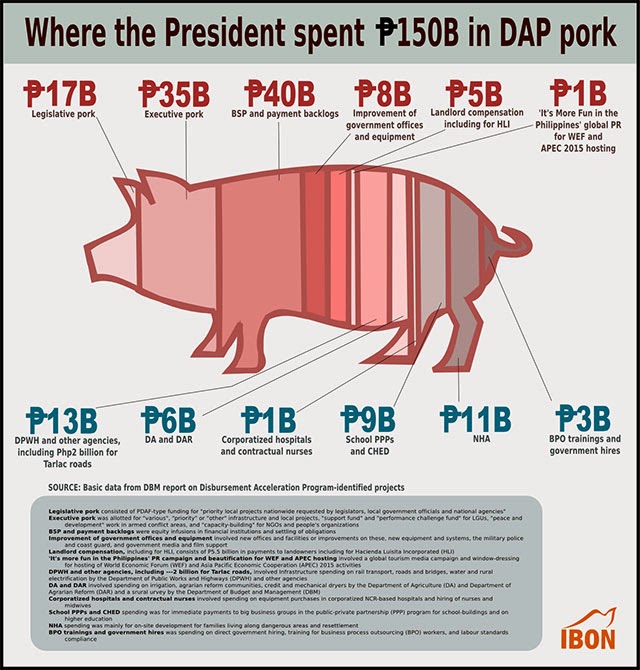
Infographics on DAP, courtesy of Ibon.
Assessed whether the DAP proved successful in pushing economic growth by investing on high-impact programs and accelerating public spending, one study has shown that the DAP as a whole did not significantly create jobs, nor raise incomes and stimulate local economic activity. According to Ibon Foundation, an independent think-tank organization, “the general pattern of DAP spending is not consistent with a stimulus package designed to address the country’s most urgent socioeconomic problems. If the government wanted to stimulate the economy, it could have prioritized labor-intensive rural infrastructure projects.”

In other words, the much-publicized positive impact of the DAP is not completely accurate as advertised. However, Joe America insists it was a highly successful program, notwithstanding its unconstitutionality for violating the budgetary process.

There are also glaring inconsistencies in Joe America’s points of view—he admits that sometimes he contradicts himself. In one blog, for example, he states that the Philippines is an authoritarian society, yet in his recent blog he advocates that the president be given wide discretionary authority because in his opinion a strong executive is not a dictator.

Just consider the last time a Philippine president hijacked his constitutional powers and ruled with an iron fist. Did becoming more powerful make him an effective leader or executive? Was he able to push the Philippine economy forward and sustain its growth?

Joe America is ignoring the true political situation in the Philippines and making wrong assumptions about our culture. Just to be fair with him, read his blog, Society of Honor by Joe America, and after that, you probably won’t read him anymore.

Thursday, July 24, 2014

Dissent and other voices


Did anyone notice the style of cause in the recent case wherein the Supreme Court has struck down certain provisions of the Aquino government’s controversial Disbursement Acceleration Program (DAP) as unconstitutional? For those who may not be aware, the style of cause refers to the name of the case.
 
High on top of the list of petitioners is Maria Carolina P. Araullo, the chair of the Bagong Alyansang Makabayan, followed by individuals known to be left-leaning and representatives of civil society organizations committed to good governance and empowerment of the people. Who else but these much-maligned groups are the ones indisputably fearless to stand up to government’s abuse of power?
 
Those from the right and many rabid supporters of President Benigno Aquino III have easily dismissed the left as irrelevant and a big disappointment. One, who was presumably affiliated before with the left and now a born-again fervent defender of the faith in the Aquino government, questioned the modes of engagement that the left have continued to embrace—the effigy burning and sloganeering that demanded impeachment of the President.
Students from various universities raise their fists after filing a second verified
impeachment complaint against President Benigno Aquino III in the House of
Representatives over his unconstitutional Disbursement Accelaration Program
(DAP). Photo by Manny Palmero.
Araullo vs. DAP, the more popular short name for the Supreme Court decision, represents the victory of people’s dissent over the arrogance of some of our leaders in government, or even perhaps the triumph of the people’s parliamentary struggle over the smugness and cockiness of the raucous rightwing-mongers.
 
Many have confused parliamentary struggle as being confined only in the halls of Congress, a tactical form of engagement strictly reduced to legislative reforms. But parliamentary struggle is not limited to congressional initiatives. It embraces the whole gamut of expressing dissent through legal means such as protests on the streets, messaging on Facebook and Twitter, confronting government decrees or acts through constitutional challenges, and private petitions or complaints of plunder against government officials. Yes, even burning of effigies. Parliamentary struggle adopts all forms of protests and advocacies so long as they do not involve violence, or taking up arms against the government.
 
Under authoritarian regimes, dissenters are persecuted. Hitler executed them, and Stalin sent them to the gulags. Surely, no one, including President Aquino, likes being ridiculed or chastised by the Supreme Court and the public. But democratic societies tolerate dissent, a proof that freedom of speech truly exists.
 
It is also why Joe America, a former banking executive who lives permanently in the Philippines and blogs relentlessly, can continuously and without fear lavish the current government with praises while he paints the Aquino critics, especially the left, as being possessed with evil motives like destroying the government by any means. Or why other defenders of the Aquino dispensation flourish and are easy to find in major Philippine dailies writing their regular columns defending MalacaƱang, and those who roam the various forums on the Internet and flood them with their supercilious and pompous opinions about anything that appears critical of the government.
 
There is nothing wrong in the present public conversation between those who believe in the government and those who are critical of it. This is how a free market of ideas is supposed to work. Give a little and sometimes take a quick poke, the battle of ideas is not won by one side when it says that wrong is right because it says so, or simply because it has been allowed or done before.
 
Just like when President Aquino insists that the DAP is right because everything he does is out of good faith and will redound to the benefit of the people.
 
In a recent speech commemorating the 150th birth anniversary of a great Filipino hero Apolinario Mabini, President Aquino said that the implementation of the DAP was reinforced by their belief that the Supreme Court itself agreed with that kind of mechanism. The president was, of course, referring to the high court’s request for a transfer of funds for the construction of the Manila Hall of Justice and the Malolos Hall of Justice.
 
“They requested for the funds to be transferred to be able to construct buildings that will house the courts. We don’t see anything wrong with this because it speeds up the judicial system in the country,” President Aquino said. The high court’s request was eventually withdrawn after petitions were filed questioning the constitutionality of the DAP.
 
There is something wrong in the President’s judgment. Just because the Supreme Court requested the fund transfer doesn’t mean that the executive can do the same for highly dubious purposes, especially after the high court cancelled their request.
 
The President cannot keep justifying the DAP or whatever he does as being good for the people. As public servant, that’s a given presumption, his covenant of good faith. He cannot rationalize his actions only by their results. More so, when there are allegations that the DAP funds were used to bribe members of Congress in impeaching former Chief Justice Renato Corona, and that the funds were also used to compensate the President’s family for Hacienda Luisita and other landowners. Where is good faith if the allegations were proved to be true?

Members of the Bagong Alyansang Makabayan point to a mascot of President
Benigno Aquino III when they declared him king of the Disbursement Acceleration
Program (DAP).
In his ubiquitous blog on the Internet, The Society of Honor by Joe America, Joe America endorses the DAP debate, “as the freedom to do that is what we fought for when we kicked out the Marcos dictatorship.” “We kicked out” is somewhat presumptuous, if not disingenuous. Joe America himself said he arrived in the Philippines in 2005, or eighteen years after the dictator was driven out of the country by the EDSA People Power Revolution. How did he become a part of the “we” who kicked out the Marcos dictatorship? Does Joe America even understand that the left greatly contributed to waking up the consciousness of the Filipino people against the oppressive Marcos regime?
 
Joe America is your typical opportunist who would dismiss the contributions of the left in building a national collective against oppression in the past, and undermine their role in the continuing struggle for people empowerment in governance. He is embraced by Filipino intellectuals, real and imagined, in their jeremiads against today’s left and the progressive movement. He now lives with his Filipino wife and son in a rural rice-growing area in the Visayas. Joe America says he is a retired banking executive with degrees in Mathematics and Radio and Television Arts. His 30-year working career was based in Los Angeles, California and he has traveled on business or personally to 21 countries. Sounds like someone who would fit the resume of an undercover political operative of an American intelligence agency.
 
Meanwhile, someone from a forum I know is already mouthing the same shibboleths as if they’re coming directly from Joe America’s pen. “Is it because parliamentary struggle requires a little more imagination and innovation, and hard work and marching to the streets and shouting to the top of their tonsils is an easier force of habit than innovating and thinking new things?,” she asks.
 
Like Joe America, she describes the left as political dinosaurs which have become obsolescent and alienated from the rest of the people. In the same vein, Joe America would caution others not to be dragged by the left into their agenda because they are wolves in sheep’s clothing.
 
Joe America and those who are like him do not represent the type of public intellectuals we would like to read and listen to. On one hand, they would pretend to encourage a robust debate, yet in truth they try to muzzle the genuine truth from coming out.
 
The voice of dissent, if we want it to be free, should be allowed to flourish without the cumbersome Joe Americas and his converts telling us that right is wrong or wrong is right just because they say so.