We always hear from politicians, especially during elections in America and in Canada, about the disappearing middle class and the need to restore, rejuvenate, and reinforce it. But the American concept of middle class is really an anomaly, if not a distortion of social reality. To make it more expansive because this is obviously where the votes are, politicians even include the working class in their definition of what the middle class is. Yet this is untrue, for the middle class is not the new proletariat.
This anomalous or perhaps opportunistic description of society’s majority as somewhat middle class in economic terms is self-betraying, especially when the political and business elite attempt to promote their social agenda. It is not exactly the greater masses or the so-called middle class that members of this highly privileged upper class mobilize or appeal for sympathy to their causes. It just happens that they are the greatest in number and they count most during elections, a time which the upper class could exploit to get them elected or to obtain the necessary stamp of public approval for their agenda.
 |
| American workers rally against capitalism. Photo by eyewash design - A. Golden. |
The real issue is whether the opinions of the average folks count. Or do they really count in the so-called bourgeois democratic forum, and that it is not only the elite’s voice that truly matters?
This seems to be at the heart of the lament of the chair of the Toronto Star, John Honderich, on the lack of outrage among Toronto’s elites over the scandalous and disgraceful behaviour of its mayor, Rob Ford, which was well-publicized in both the news and social media late last year.
Honderich was particularly surprised why Toronto’s elite were rather silent, as if their voice was not significant anymore. Truth to tell, to Honderich and his fellow members of the elite, the opinion of the Toronto average folks doesn’t weigh as much as theirs. This is why Honderich was deeply disturbed that the elite never spoke up to register their disgust over the mayor’s public display of shame and embarrassment.
Honderich was particularly surprised why Toronto’s elite were rather silent, as if their voice was not significant anymore. Truth to tell, to Honderich and his fellow members of the elite, the opinion of the Toronto average folks doesn’t weigh as much as theirs. This is why Honderich was deeply disturbed that the elite never spoke up to register their disgust over the mayor’s public display of shame and embarrassment.
But to his dismay after his newspaper canvassed their opinion about Mayor Ford’s behaviour, close to half of the respondents who replied declined to comment, with four sending comments that neither criticized nor defended the mayor.
Was this kind of validation exercise from the so-called elite necessary in a democratic forum?
Toronto’s mayor was already disrobed, his cocaine snorting publicly admitted, together with his association with known criminals. What did Honderich need more in order to secure public validation of the elite’s disgust over their mayor? The municipal elections are looming in a few months and they are the most effective means of rejecting a politician who is both a national embarrassment and a disgrace to public office. Or is Honderich afraid that Ford might get re-elected?
This is a dilemma that commonly afflicts bourgeois democracy. While it claims it is representative of all classes in society for they can choose their government and leaders by means of the ballot, the matter of popular representation is easily manipulated by the elite who control the economy. Free election is an important feature but the results indicate that the system is largely dominated and rigged by the powerful elite, leaving the poor and greater masses really powerless and unrepresented by people from their ranks. Thus, elections in a bourgeois democracy become no more than a cynical and systemic attempt to deceive the people by permitting them to endorse one or other of the bourgeoisie's predetermined choices of which can best represent and advocate the interests of capital.
A major Philippine newspaper, for example, reported recently that in a survey conducted by the Social Weather Stations (SWS), majority of Filipinos (about 11.8 million families) would consider themselves as poor. This is a slap on the face of the incumbent Aquino government which has been promising to achieve inclusive growth, an improvement that it claims would trickle down to the greater majority of the population.
However, the Aquino government dismisses this self-rated poverty by the population on the simple ground that the government uses a different set of benchmarks to determine poverty statistics. The government commits the most brazen form of self-denial in ignoring the people’s self-assessment of their impoverished condition. It is the same as saying the people’s true condition does not really matter to the government for as long as their parameters show otherwise.
Could there be any better indicator of poverty than the self-assessment of the people of their true condition? Wherein lies the truth: from the voice of millions who acknowledge their own impoverishment or from official government pronouncements that poverty alleviation programs are working and incidence of poverty has been significantly reduced?
If your own government does not care about your suffering, do you continue to regard the people you have elected as representing your interests and welfare? When poverty alleviation programs like the Conditional Cash Transfer (CCT) have become dole-outs that encourage mendicancy and entitlement, until when will this government admit that its policy of inclusive growth is flawed?
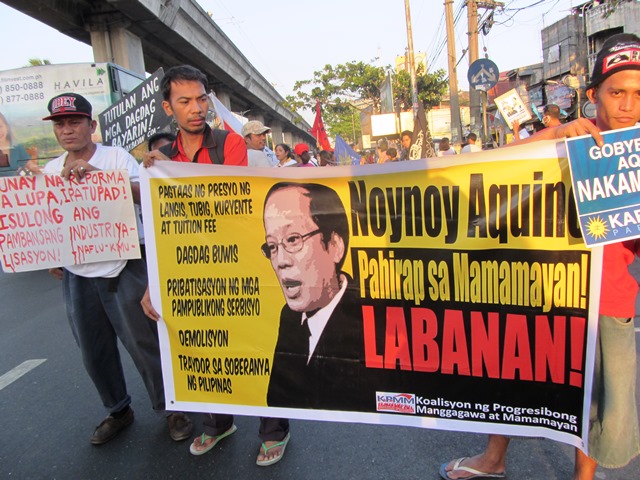 |
| Filipinos protest Aquino government's anti-people policies. Photo by Marya Salamat/Bulatlat.com |
This government has been implementing policies and decisions that are essentially against the people. The electricity rates in the Philippines are the highest in the world today. Twelve years ago, the Electric Power Industry Reform Act (Epira) was enacted to give consumers a choice of service providers so they can take advantage of lower electricity rates. The premise behind Epira was that free market competition would flourish and it is for the benefit of the consumers.
But Epira was a big joke and privatization of electric power has failed miserably. The Manila Electric Co. (Meralco) continues to be the only utility distributor that matters, making more than 5.3 million consumers powerless to oppose ever-increasing electricity bills.
Competition among power generators has not resulted in lower power costs. The Wholesale Electricity Spot Market (WESM) is no more than a mechanism to create the illusion of competition.
Yet this government continues to trumpet the commercial success of the Malampaya natural gas project in Palawan which promises to deliver the country from dependence on importing foreign oil for power generation. The Malampaya Project is supposed to fuel three natural gas-fired power stations with a total generating capacity of 2,700 megawatts that could provide 40-45% of Luzon's power generation requirements. Apparently, the government is simply satisfied with the annual $US 1 billion royalty payments it gets from the project operators, a large sum of money that goes to the president’s social fund, otherwise known as the president’s pork barrel.
In addition to natural gas power, the Philippines since 1983 has also become the second largest producer of geothermal power in the world. The Energy Development Corporation (EDC), founded under the Philippine National Oil Company (PNOC) in 1976, has been generating electricity for Ormoc and nearby towns in Leyte. Ormoc was recently on the cross path of super Typhoon Yolanda which hit the Philippines late last year. EDC, which became a private corporation in 2007, also has three other operating power plants in the country, all designed to generate energy from indigenous sources and lessen the country’s dependence on imported fuel.
Although initially operated as public utilities, all local sources of power generation and distribution, natural gas project explorations and geothermal energy production have all been transferred in the hands of the private sector. All in the misguided belief that privatization would somehow be more efficient because of free competition in the market. The trouble with privatization is that unregulated monopolies have entrenched a regime of limited choice at the expense of consumers and taxpayers.
And if you have a government that is powerless and would rather throw its hands in capitulation to the private sector, when does this government become a genuine advocate for the interests of the people?
Liberal or bourgeois democracy under the capitalist or free enterprise system can never truly be democratic or representative of the greater population. Ultimately, politicians fight only for the interests of their class. Popular elections in a bourgeois democracy are nothing but the appearance of having the power of decision of who among the ruling classes will represent the people in running the government and enacting legislation.
Thus, a liberal newspaper like the Toronto Star would rather prefer the elite to have a voice in issues that affect the city and treat the greater masses as important only when they turn out to vote during election time. Honderich and other elitists like him don’t care about the opinions of the average folks. They keep the masses from realizing that their will is irrelevant in the political process, while at the same time maintain a conspiracy for making them restless for some political agenda
In the same manner, the democratic process in the Philippines, despite its so-called free elections and political representation, is just as flawed and as deceptive because the government that has been installed by the majority of the electorate ignores the conditions of the people when it comes to governance, and ultimately works only for the interests of the privileged few and the entrenched elite.


